
A branded van spends most of its day in front of people who never chose to look at it. It waits beside them at traffic lights, passes them on Sheikh Zayed Road and parks outside the shops and offices they visit. That makes a vehicle one of the most visible things a business owns. It also makes it easy to waste, because a van covered in information nobody can read does little more than a plain one.
This guide covers how to plan vehicle branding for a single van or a whole fleet in Dubai: the surfaces and what each should say, bilingual layouts, the rules to check, the difference between design and wrap production, and how to keep a growing fleet consistent.
Start with what the vehicle needs to say
Before anyone draws a layout, decide what a person should understand after seeing the vehicle for a few seconds. For most businesses that is three things, in this order: who you are, what you do and how to reach you. Everything else comes second.
A logo on its own is rarely enough. People may recognise the name but have no idea whether the vehicle belongs to a food supplier, a cleaning company or a vending business. A short line that names the offer often does more than a bigger logo. On the Bettergrow delivery truck, the orange wordmark sits with the line “From Sourcing to Shelf” and five icons that name the product categories, so the offer reads from a distance.
Plan every surface, not just the side
Each surface of a vehicle is seen from a different distance, at a different speed, by a different person. Plan them together before preparing individual panels.
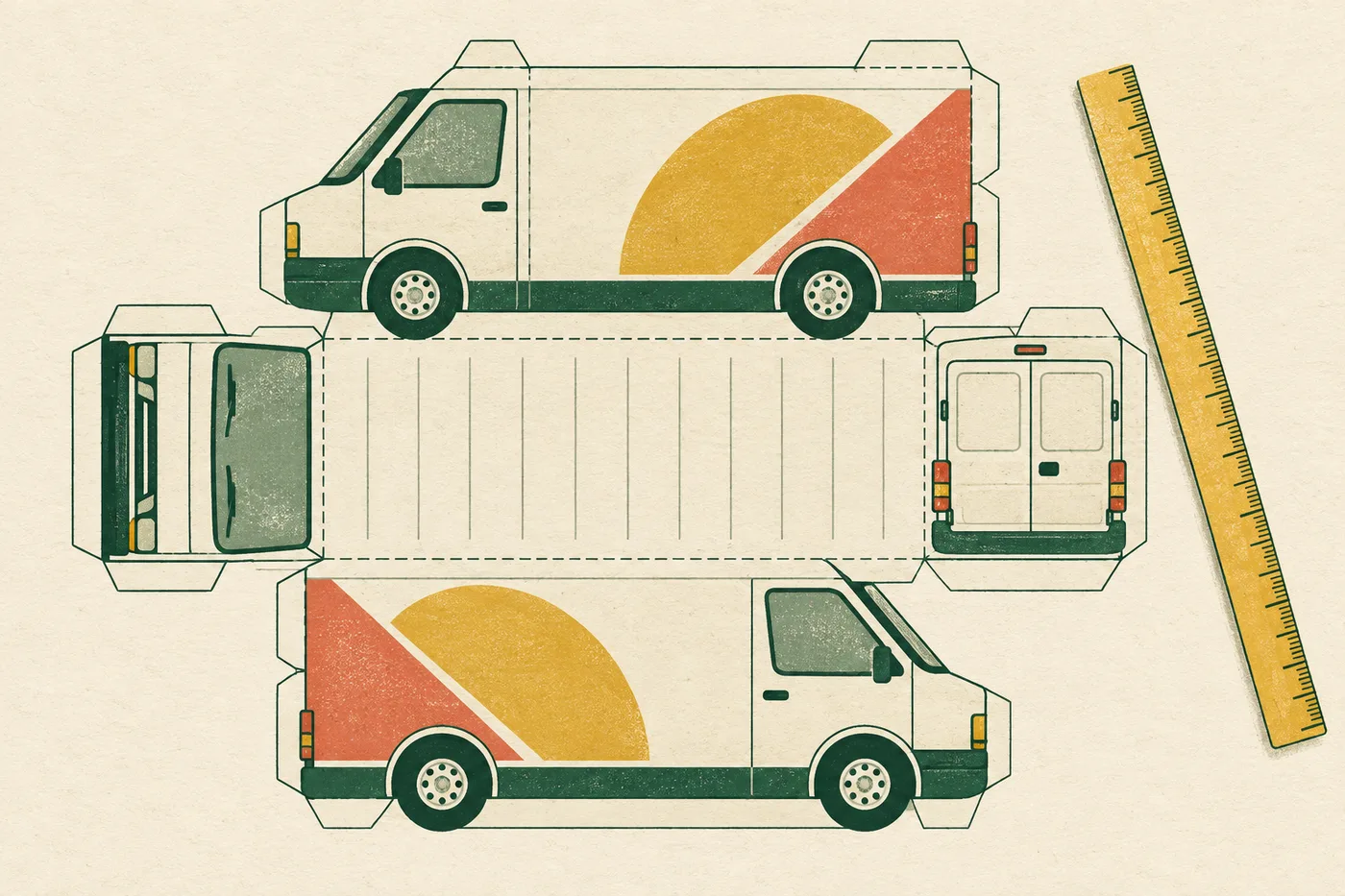
- The sides are the largest surfaces, seen by pedestrians and drivers in the next lane. They carry the name, the offer and the main image.
- The rear is read by the driver behind, often while waiting at a junction or in traffic. It suits one short message and a contact point that is easy to remember.
- The front is mostly seen in mirrors and by oncoming traffic. A logo is usually enough.
- The cab doors are seen up close when the vehicle is parked, which makes them a sensible place for the company name, phone number and website.
- The roof is only worth designing if people will see it from above, from bridges, towers or multi-storey car parks.
Our case studies show these surfaces doing different jobs. The Bettergrow rear doors ask a single question a driver can read at a junction, with the services, website and phone number underneath. Modern Vending builds the vending unit into the side of the van, and its roof reads “Snacks on the move” in large white capitals for anyone looking down.
Design around the real vehicle
A layout that looks right on a flat drawing can fall apart on a real van. Doors, handles, fuel caps, windows, body seams, the ribs on box bodies and sliding door tracks all interrupt the surface. A phone number split by a door gap, or a face cut in half by a handle, weakens the whole design.
Work from accurate templates for the exact make, model and year, or measure the vehicle, and take clear photographs of every side. Keep important text and logos on flat, uninterrupted panels, and use the areas around openings for colour and pattern rather than words.
Design for reading at speed. Use large, simple lettering, strong contrast between text and background and as few words as possible. Long lists of services, small print and complicated web addresses rarely get read on a moving vehicle.
Arabic and English layouts
In the UAE most business vehicles benefit from both languages. The question is how to arrange them without crowding the panels.
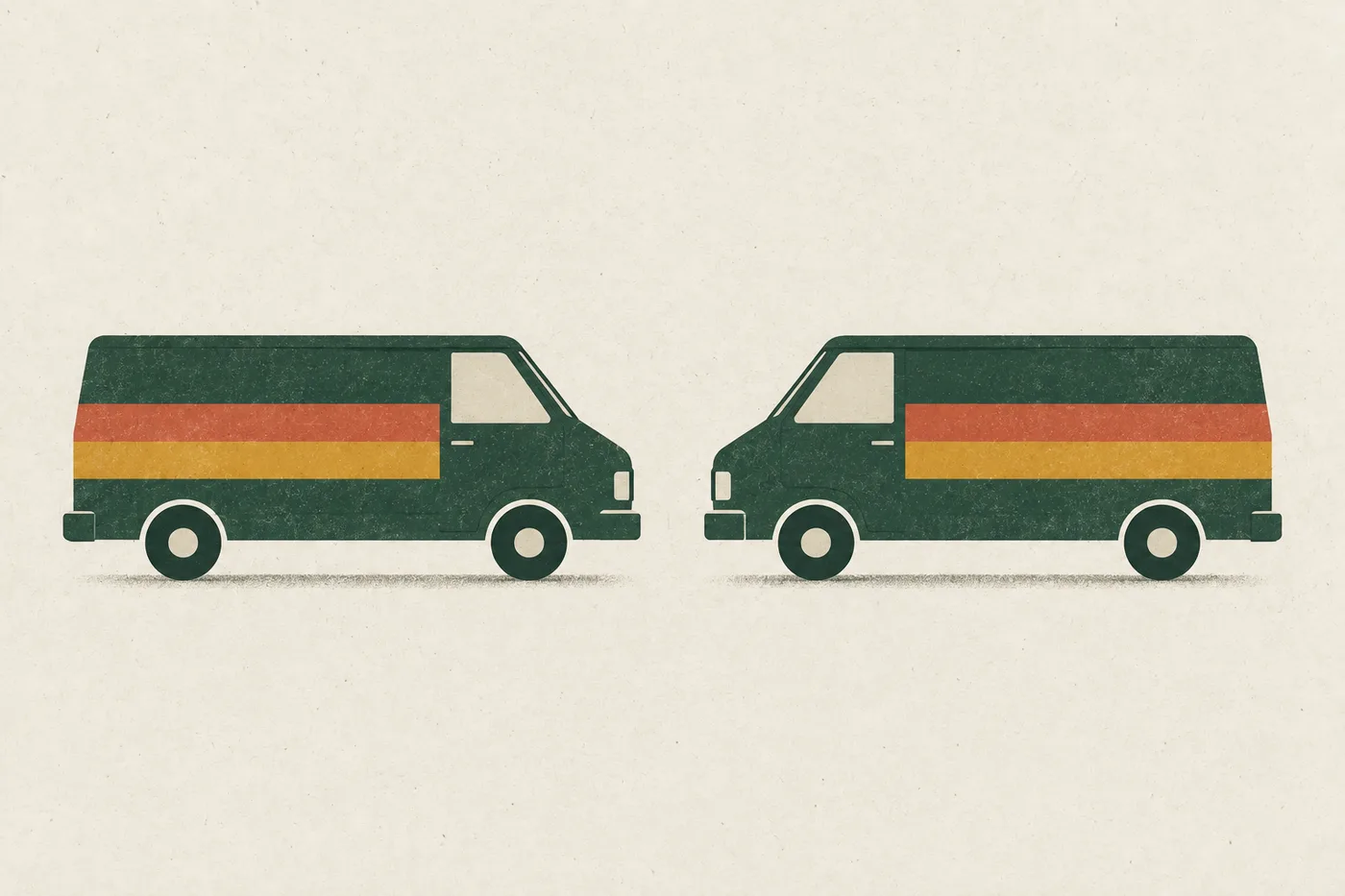
One approach gives each side its own language, English on one side and Arabic on the other, with the same structure so the vehicle reads as one brand. Talal Market’s van does this, with the wordmark, a rewards line, a graphic and app badges in the same order on each side. Another approach sets both languages together. iD Fresh Food uses an English side and an Arabic side, then brings both languages together on the rear doors with the line “Fresh food on board”.
Arabic reads from right to left, which affects how a layout flows. On a vehicle the direction of travel matters too, because a composition that seems to move forward on the driver’s side can seem to move backwards when it is simply mirrored on the passenger side. Plan both sides deliberately rather than flipping one onto the other, and have the Arabic written or checked by a native speaker.
Check the rules before the graphics go on
Advertising on vehicles in Dubai is overseen by the Roads and Transport Authority (RTA). Executive Council Resolution No. (47) of 2017 regulates businesses licensed for activities such as transport, logistics, delivery services, vehicle rental and selling goods from vehicles. It requires those businesses not to stick or hang any advertising material on the body of a vehicle without first obtaining the relevant approval of the RTA, and its schedule of fines lists AED 5,000 for doing so. The same resolution requires the name of the business and the vehicle’s kerb and gross weight to be shown clearly on each vehicle, as the RTA prescribes. You can read the full text of Resolution No. (47) of 2017 on the RTA website.
Requirements depend on your licence, the vehicle and the emirate it is registered in, and they can change, so confirm the current approval process with the RTA or your wrap supplier before production. Leave room in the design for any required markings, so they do not have to be squeezed in after the artwork has been approved.
Design versus wrap production and fitting
Vehicle branding involves two different jobs, often handled by different companies. Design covers the message, the layout and the artwork. Production covers printing, laminating, cutting and fitting the graphics to the vehicle.
The designer prepares the artwork, but the final files have to follow the measured vehicle and the specifications of the wrap supplier, including bleed, panel joins and the material being used. Agree early who measures the vehicles, who prepares the print-ready files, who checks the proofs and who is responsible if a panel does not fit.
Coverage changes the production scope. Cut vinyl lettering and logos on a coloured vehicle are the simplest. Partial wraps cover selected panels. Full wraps cover the whole body and need more material, more fitting time and more careful artwork around every opening. Removing old graphics and preparing the surface are separate tasks that suppliers usually price on their own.
This is why design and production are normally quoted separately. For our vehicle branding service, the proposal separates design from production and fitting, and sets out who is responsible for each step before the artwork goes into production.
Keeping a fleet consistent
Fleets rarely stay the same. A business starts with two vans of one model, then adds a box truck, a pickup and a newer van with different panel sizes. Without rules, each new vehicle gets its own one-off layout, and within a few years the fleet looks like several different companies.
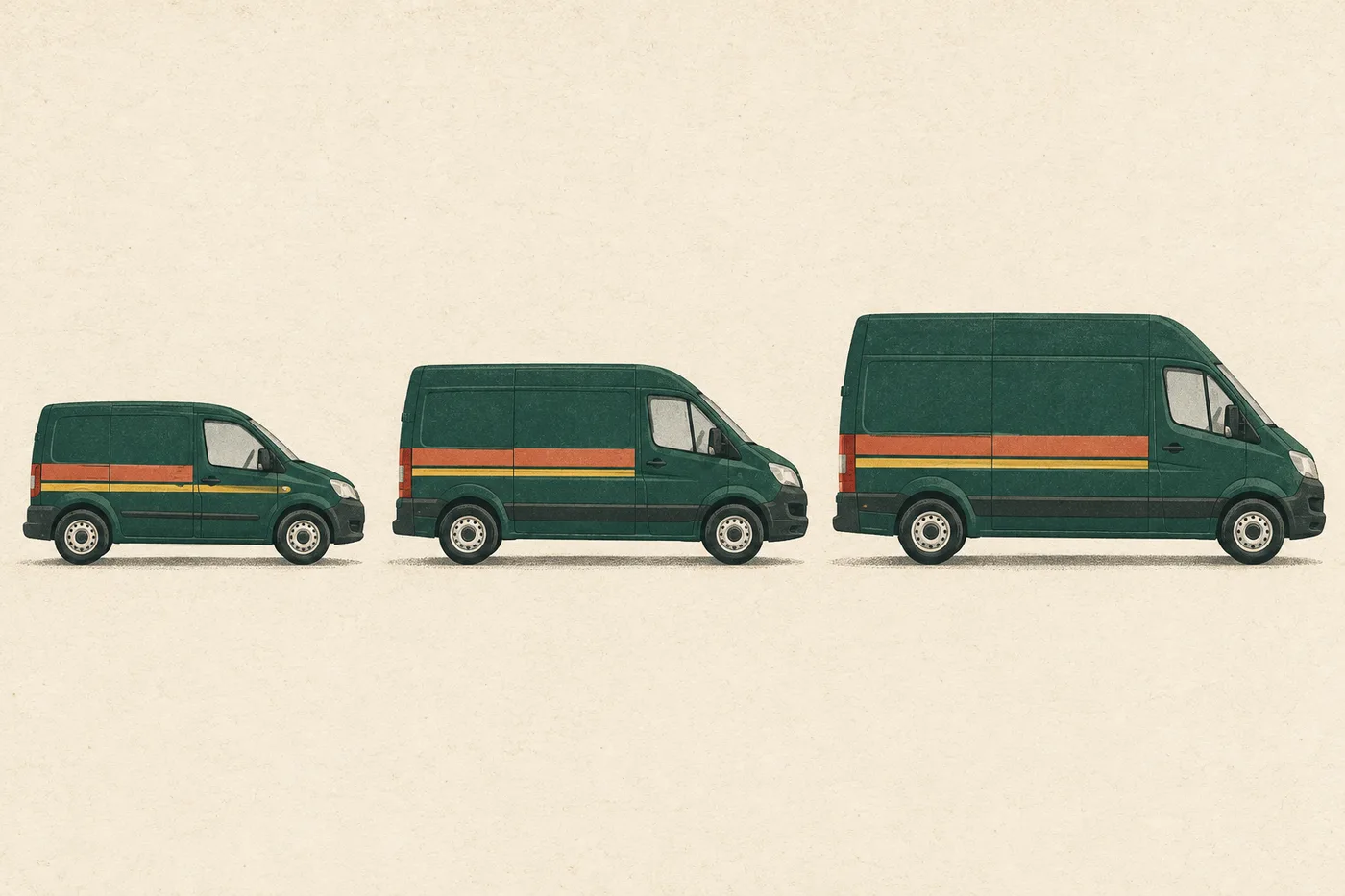
The answer is not one layout forced onto every body shape. It is a short set of rules that travel from vehicle to vehicle:
- Which colours cover the body, and in what proportions.
- Where the logo sits on each surface, and its minimum size.
- The message hierarchy: what is read first, second and third.
- How the Arabic and English versions are arranged.
- Where the contact details go, and exactly what they say.
- Approved artwork files for each vehicle model in the fleet.
Keep these rules in a short vehicle guide alongside your brand guidelines, and send it to every wrap supplier you use. When the offer, phone number or website changes, update the guide first, then plan a replacement schedule so old and new liveries are not mixed for longer than necessary.
What to prepare before you brief a designer
- Your brand guidelines and logo files, in both languages if you have them.
- The make, model and year of every vehicle, and how many of each.
- Clear photographs of every side, and measured drawings if you have them.
- The message, offer and contact details that must appear.
- Where the vehicles drive and park, and who usually sees them.
- Your rollout date, and whether a wrap supplier is already appointed.
Frequently asked questions
Do we need RTA approval to brand a company vehicle in Dubai?
Businesses covered by Executive Council Resolution No. (47) of 2017, which includes transport, logistics, delivery, rental and selling goods from vehicles, must not place advertising material on a vehicle body without RTA approval. Confirm the current requirements for your licence and vehicles with the RTA or your wrap supplier before production.
Should vehicle graphics be in Arabic and English?
For most businesses in the UAE, yes. You can give each side its own language with the same structure, or set both languages together on one panel. Either way, plan the two versions together.
Is a full wrap better than vinyl lettering?
Not necessarily. A full wrap has the most visual presence but takes more material and fitting time. Well-planned cut graphics on a coloured vehicle can be just as clear. The right choice depends on the message, the budget and how long you plan to keep the vehicle.
Does a design quote include printing and fitting?
Usually not. Production depends on the material, the coverage, the vehicle and the installation, so it is quoted separately. Agree who is responsible for each step before the artwork is approved.
How do we keep new vehicles consistent with the old ones?
Keep a short vehicle guide with your colour, logo placement, message and language rules, plus approved artwork for each model. Send it to every supplier and update it whenever the details change.
For practical support with this decision, explore our vehicle branding and brand identity and logo design services. Each page explains the scope, how we work and what to consider before commissioning the work. Talk to us about your business challenge.