The order matters more than any single design choice. Many expensive mistakes in food branding are sequence mistakes: a sign made before the trade name was confirmed, cups printed with a logo that was still changing, an Arabic name added by the signmaker at the last minute. Dubai Municipality counted 1,898 new food establishments in the first half of 2026, around 10.5 a day, and 29,303 in total, so a new place also has to be recognisable on a busy street and a crowded delivery app from its first week.
The checklist at a glance
- Concept and guest: what the place is, who it is for and why they would choose it over the café next door.
- Name: checked for meaning and sound in English and Arabic, and confirmed as the trade name with your licensing adviser.
- Identity: logo, colours, type and a pattern or symbol, in English, Arabic and combined versions.
- Shopfront sign: designed from the approved lockups, sized for the actual fascia.
- Takeaway range: cups, lids, bags, boxes, wraps and stickers designed as one set.
- Menu and in-store print: printed menu, menu board and table items in both languages where needed.
- Uniforms: shirts, caps and aprons that match the rest of the brand.
- Photography: the real dishes and the space, shot for the menu, the delivery listing and social media.
- Delivery listing and social profiles: a version of the logo that reads small, plus the photographs.
- Files and guidelines: one set of approved artwork that every printer and supplier works from.
Start with the concept and the guest
Before a logo, write down in plain words what the place is and who it is for. A mandi restaurant built around family meals needs a different brand from a takeaway tea counter, even on the same street. The original inspiration for Waqtal Mandi centred on kinship and a shared meal, and that idea became a shared-platter symbol. Hotshay’s board of steaming tea and leaves set the direction for a tea café’s mark.
Two or three sentences are enough: the food, the guest, the price level and the one thing you want people to remember. Every later decision, from the colour of the cup to the tone of the menu, is checked against them.
Settle the name before anything is drawn
The name on your sign, your trade licence, your delivery listing and your social handles should match. Agree the trade name with your licensing adviser before the logo is final, because a change afterwards means new artwork, new print and sometimes a new sign. Check that the domain and the main social handles are free while the name is still a shortlist.
Decide the Arabic name at the same time. It can translate the meaning, carry the sound across or be a separate name. Bawabat Al Khawaneej puts a place and a food category into one name, and the identity had to make both ideas visible in Arabic and English. If the name is invented, as with Kukit, an Abcon Group venture built from “cook” and “it”, check how it sounds and reads in Arabic too.
Design the identity in Arabic and English together
Customers in the UAE will see your Arabic name on the sign, the bag or the menu, so it needs the same care as the English. Drawing the two together, with matching weight and proportion, is the difference between one brand and two. Snap Chay’s English and Arabic lockups share a yellow-and-navy system and a repeated symbol; 4 Bites Shawerma’s symbol is built from the Arabic 4, the number 4 and the letter B, so it belongs to both languages.
Ask for three versions of the logo: English only, Arabic only and combined. Each has a job. Our guide to Arabic and English logo design explains the craft, and our bilingual branding page shows how to check the Arabic if you do not read it.
The shopfront: the sign people see first
For a walk-in restaurant, the sign is the brand’s largest and most permanent item, so design it from the approved lockups and the real fascia measurements, not a stock photograph. Check how it looks at night: Waqtal Mandi’s presentation shows the name in Arabic and English on an illuminated night shopfront, because that is when many guests first see it.
Shop signs in Dubai usually need approval, and the rules depend on the location and the building. Your signmaker and landlord will know the current requirements; involve them early and give them vector files of each lockup. Within Abcon Group, Abjar Signboard Works can produce and install the signs we design, so the sign matches the artwork.
What the takeaway order has to carry
For a takeaway or delivery customer, the packaging is the restaurant. Plan the whole order at once, not one box at a time: hot and cold cups and lids, carrier bags, boxes in each size, wraps, sleeves, stickers and tissues. Al Ijaza’s range carries a red-and-cream palette, a handwritten name and a geometric band across all of them, using a different proportion of each on every format.
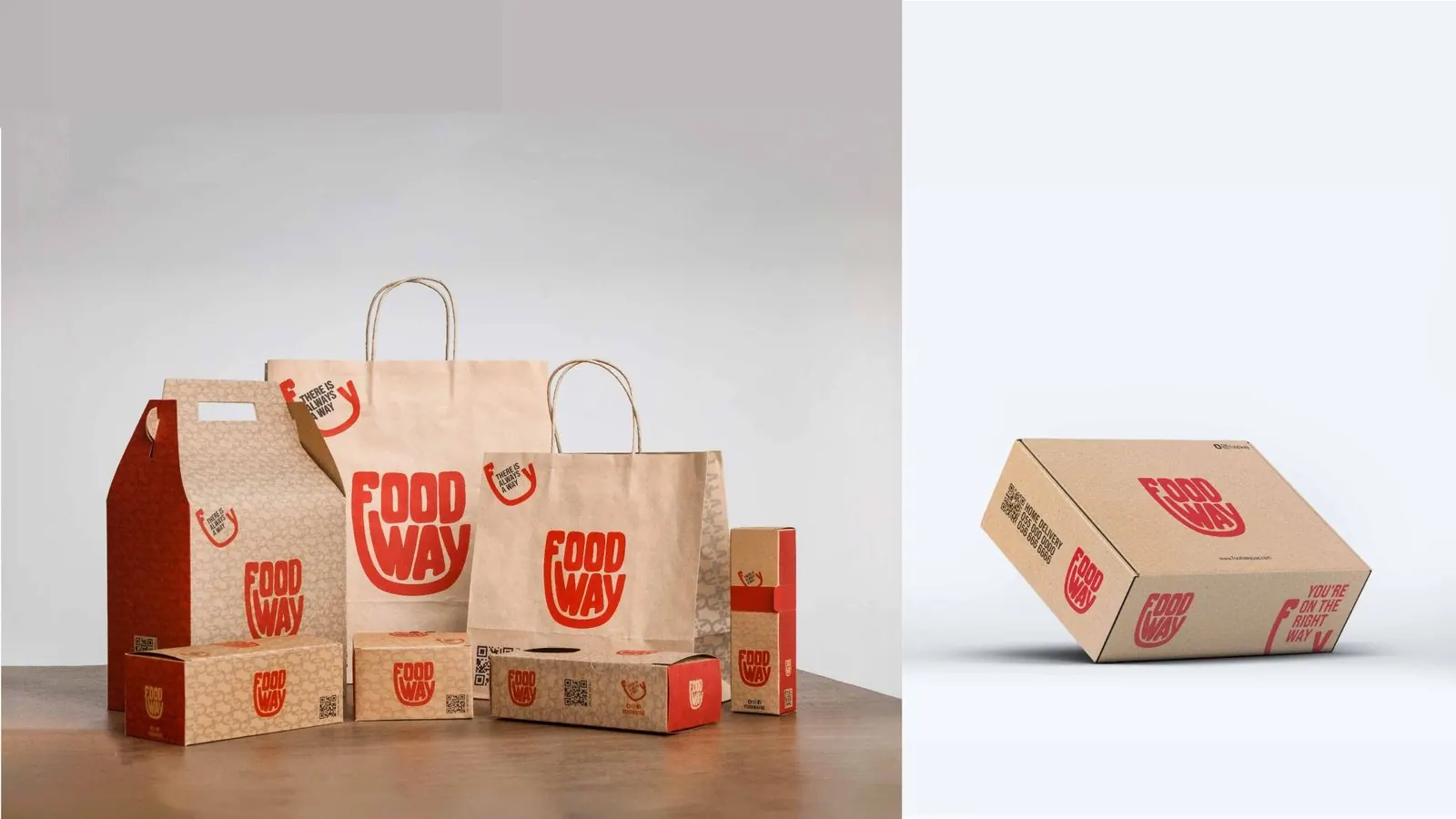
One mark across the whole takeaway order
Food Way’s original boards plan the takeaway range as one set: the red wordmark on kraft bags, carry boxes, food boxes and a shipping box. The same mark also comes in black and white versions, the kind a single-ink print on kraft needs, and a light pattern carries the brand onto the pieces too small for the logo.
Original project presentation · Read the Food Way case study
- One detail that repeats. A band, a pattern or a symbol that survives on the smallest item, like the sleeve on a fries carton.
- A version for one ink on kraft. Kraft bags and boxes often print in a single colour. Al Mamzar’s identity was briefed to stay recognisable when the print drops from full colour to a single ink on kraft.
- Both languages, planned. Decide which items carry English, Arabic or both. Al Ijaza has an English kraft bag and an Arabic kraft bag with the same layout, and clear cups with both names.
- A sticker or label system. Plain stock packaging with a branded seal is a sensible start when budgets are tight; add printed boxes as the menu settles.
Write down every item you will order in the first month, with sizes, before design starts. It keeps the scope honest and stops a forgotten item arriving unbranded.
Menus, uniforms and the small things
The menu is read more closely than anything else in the room. Set it in the identity’s type, in both languages where your guests need them, and leave space for items and prices to change without a redesign. Al Ijaza’s menu brings the packaging pattern into the printed menu with bilingual naming.
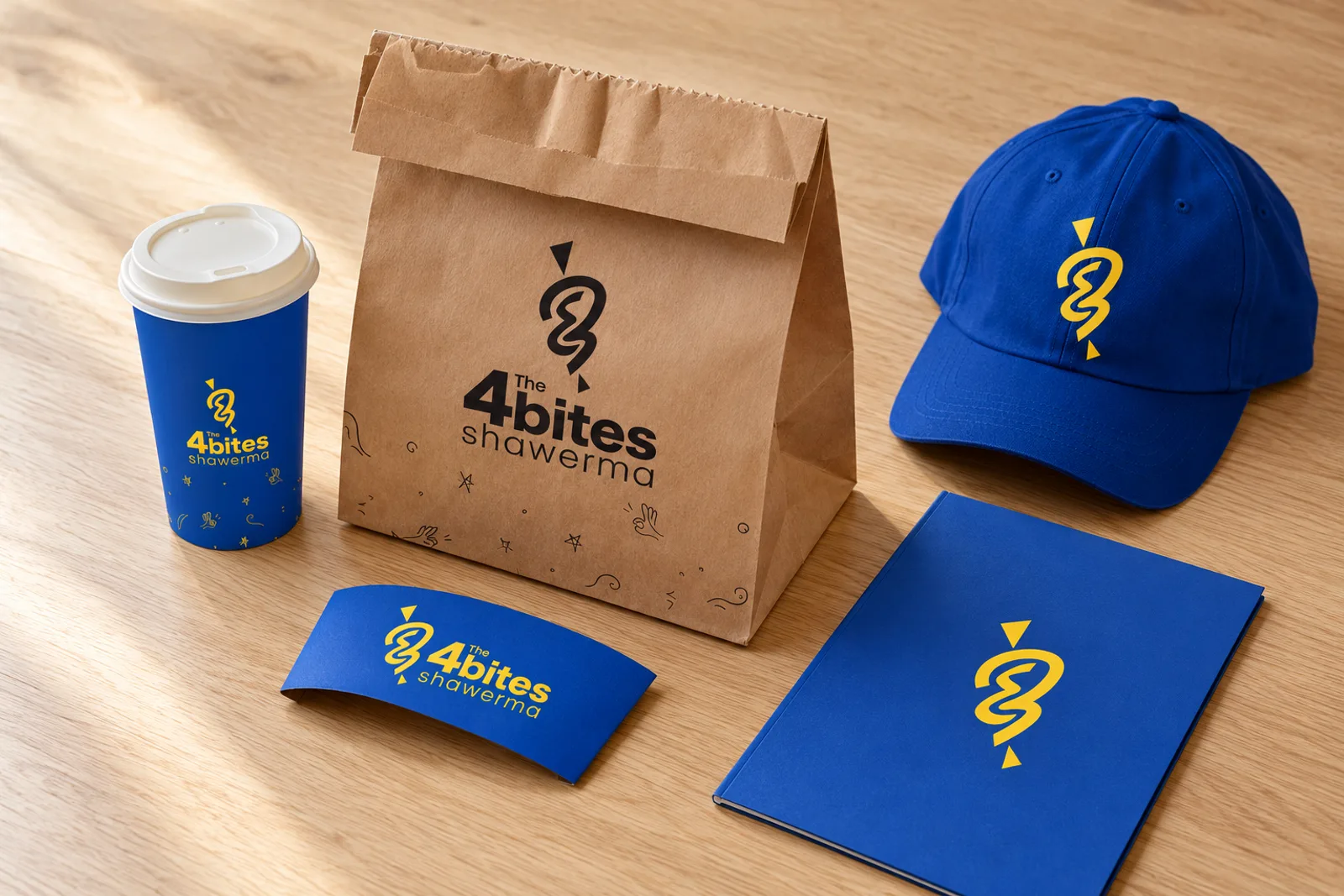
Uniforms put the brand on the people serving it: Burger Hub’s presentation includes staff polo shirts, and 4 Bites Shawerma’s carries the identity onto staff clothing. Add the receipt layout, the loyalty card and the table tent to the list, because they are easy to forget and seen every day.
Delivery apps, photography and social media
On a delivery app your brand is a small square logo and a few photographs among dozens of others. Make sure the identity includes a version that reads at that size, usually the symbol on its own or a short stacked name, and check each platform’s current image requirements before the shoot, because they set the sizes and change them.
Photograph the real dishes, plated the way they will arrive, and the space if guests eat in. The same pictures serve the menu, the listing and social media, so plan one shoot for all three. Set up the social profiles with the same name, the same profile mark and a few post templates before you open.
The order of work before opening day
| Step | Decide | What it unlocks |
|---|---|---|
| 1. Concept | The food, the guest, the price level, the one thing to remember | Every design choice that follows |
| 2. Name | English and Arabic name, confirmed as the trade name | Logo design, domain, social handles, licence paperwork |
| 3. Identity | English, Arabic and combined lockups, colours, type, pattern | Sign, packaging, menus, uniforms |
| 4. Sign | Final fascia artwork from the approved lockups | Sign approval and production |
| 5. Packaging and print | The full takeaway range, the menu and in-store print | Supplier orders and print runs |
| 6. Photography and listings | The shoot list, the small logo version | Delivery listings and social profiles |
Tell your branding team your opening date at the start so the work can be planned back from it. Sign production and packaging print runs usually take longest, so their artwork should be approved first.
Common mistakes
- Printing cups and bags before the logo is final, then reprinting them.
- Letting the signmaker or printer set the Arabic, so it looks like a different brand.
- Designing only the logo and leaving the bags, boxes and menus to suppliers’ templates.
- A logo with fine detail that disappears on a delivery app tile or a one-colour kraft bag.
- Choosing a name before checking the trade name, the domain and the social handles.
Frequently asked questions
What should we brand first for a new restaurant?
The name and the identity, in English and Arabic, because the sign, the packaging, the menu and the delivery listing all use them. Then whatever takes longest to produce, which is usually the sign and the printed packaging.
Do we need an Arabic version of our restaurant logo?
For a restaurant in the UAE it is usually worth it. The Arabic is likely to appear on the sign, the bags and the menu, and it is better designed once with the English than improvised later by each supplier.
Can we start with plain packaging and stickers?
Yes. Stock cups, bags and boxes with a branded sticker or stamp are a sensible way to open while the menu settles. Design the sticker from the identity, then add printed packaging for the items you sell most.
How much does restaurant branding cost in Dubai?
It depends on whether you need a name, how many packaging items there are, whether one outlet or a chain is planned, and how much signage and photography is involved. Our guide to branding costs in Dubai explains what moves the price.
How Abcon can help
Restaurants, cafés and food brands make up most of our portfolio, from Snap Chay and Waqtal Mandi to Al Ijaza, 4 Bites Shawerma and Burger Hub. We design the name, the bilingual identity, the packaging, the sign and the menus as one system, and Abcon Group’s Abjar Signboard Works can produce the sign. See our restaurant and café branding service, or tell us about your opening.
For practical support with this decision, explore our restaurant and café branding and bilingual branding services. Each page explains the scope, how we work and what to consider before commissioning the work. Talk to us about your business challenge.